
How does an insulation fault occur, and how do you fix it?

How does an insulation fault occur with an inverter, and how do you solve it? During humid weather conditions, the number of installations with insulation faults increases. Detecting such a fault can only be done when it is actively present. Often, the insulation fault occurs in the morning and may disappear once the moisture has evaporated. In some cases, it’s hard to trace. It’s often caused by sloppy installation work.
WARNING! Touching uninsulated metal parts of the string or frame can result in serious injury. Always use appropriate safety gear and safe measuring tools.
Causes of an insulation fault
Insulation faults are usually a short circuit between DC and PE (protective earth):
- DC connectors are exposed to too much moisture or are submerged in water
- DC connectors are not properly assembled
- DC cabling is worn or chafed
- DC cabling is of poor quality
- DC connectors are of poor quality
Rare causes
- One or more PV module junction boxes are damaged, allowing moisture to enter
- One or more PV modules are heavily damaged due to external causes, allowing moisture to reach the cells
- The inverter itself generates the insulation fault
Recommended measuring and testing equipment
- Multimeter (at least CAT III, capable of measuring 1000 VDC)
- Megger (Insulation resistance tester), preferably one that can also measure Voc (open-circuit voltage) and Isc (short-circuit current)
- AC/DC Inverter starter kit (explained further below)
How is an inverter insulation fault displayed or detected?
Error messages shown on the inverter display include: “isolation error”, “isolation fault”, “ISO-Pro0x”, or “Low Insulation Resistance”. While this error is active, the inverter will not convert power for safety reasons. Dangerous voltages could be present on conductive parts of the system.
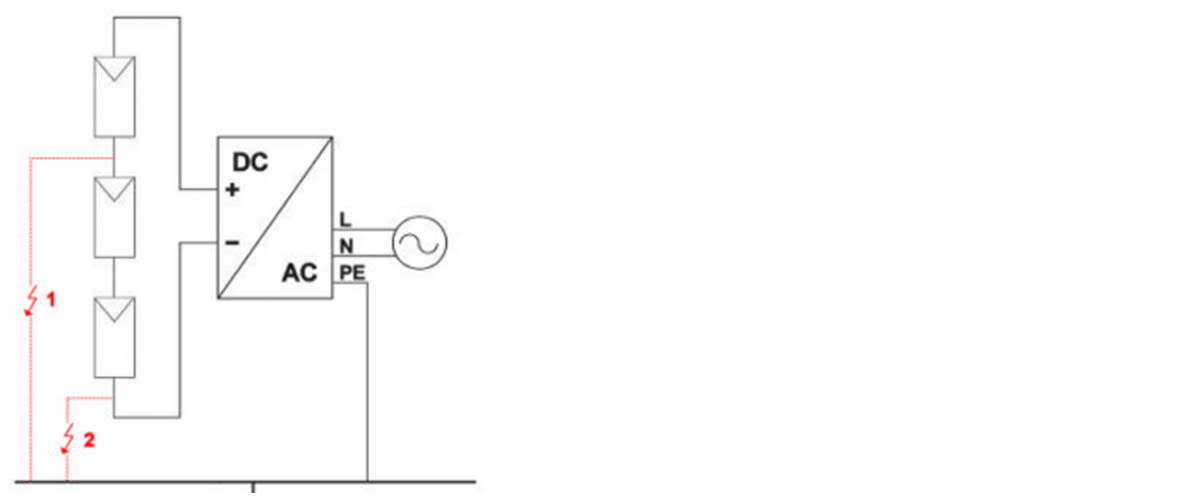
Image: possible locations for closing of direct current to earthing.
As long as there is only one electrical connection between DC and PE, there is no immediate danger, the circuit remains open. However, the risks remain:
- A second ground fault at PE (2) causes a short-circuit current through the modules and cabling, increasing the fire risk
- Touching the modules can result in serious personal injury
It is therefore crucial that the metal frame of all active PV modules is properly grounded. Do not only connect grounding to the inverter housing. Connect the grounding cable either directly to a certified earth rod or run the cable alongside the + and – DC cables to the inverter and connect it to the PE wire in the AC main switch. Avoid mixing different conductor diameters.
Detecting an inverter insulation fault
To avoid time-consuming measurements too early, note that some inverters may temporarily generate an insulation fault themselves. This can show up on the display or be stored in the fault log. If the system is online, it may also appear in the monitoring portal.
To test the inverter itself, you can use the AC/DC Inverter Starter Kit, even without sunlight.
Procedure:
- Turn off both the DC and AC switches
- Disconnect all DC cabling but keep DC+ and DC– of each string together
- Connect the starter kit to the first MPPT, then turn on both AC and DC
- If the insulation fault appears during startup or power generation on the display or inverter app, the inverter is defective
If the inverter is under warranty and purchased from Libra Energy, you may request an RMA (Return Merchandise Authorization) via our webshop using the completed digital RMA form. If approved, a replacement inverter will be provided.
Repeat the procedure for each MPPT input until all have been tested. If no insulation fault is shown, proceed with the next measurement using a megger.
Localizing the insulation fault via measurements
- Turn off the AC main switch
- Turn off the DC main switch
- Disconnect all DC cables but keep DC+ and DC– of each string together
- Measure the open-circuit voltage (Voc) of each string and document or photograph the readings
- Disconnect the PE (earth) from the inverter
- Use a DC voltmeter to measure voltage between PE and DC+ and between PE and DC–, then note or photograph both voltages
You’ll see that one or more strings do not show 0 volts. These strings contain an insulation fault. The voltages help identify the fault location.

Example: String with 9 PV modules, Voc = 300 V PE to +DC (V1) = 200 V → modules 1–6 PE to –DC (V2) = 100 V → modules 7–9 Fault is likely between module 6 and 7.
WARNING! Touching uninsulated parts of the string or frame can cause serious injuries. Always use proper protection and tools.